

We think about sound the way few people have to.
Aurallius is an acoustic control company. We design passive, geometry-driven structures intended to reshape where sound goes — for the machines defending, delivering, serving, and building the world around you.

We shape sound. We don't just quiet it.
Most acoustic engineering starts from the question of how to make a machine quieter. We start from a different one — where should its sound go? Once you ask that, the work stops being a fight against sound and becomes a matter of directing it.
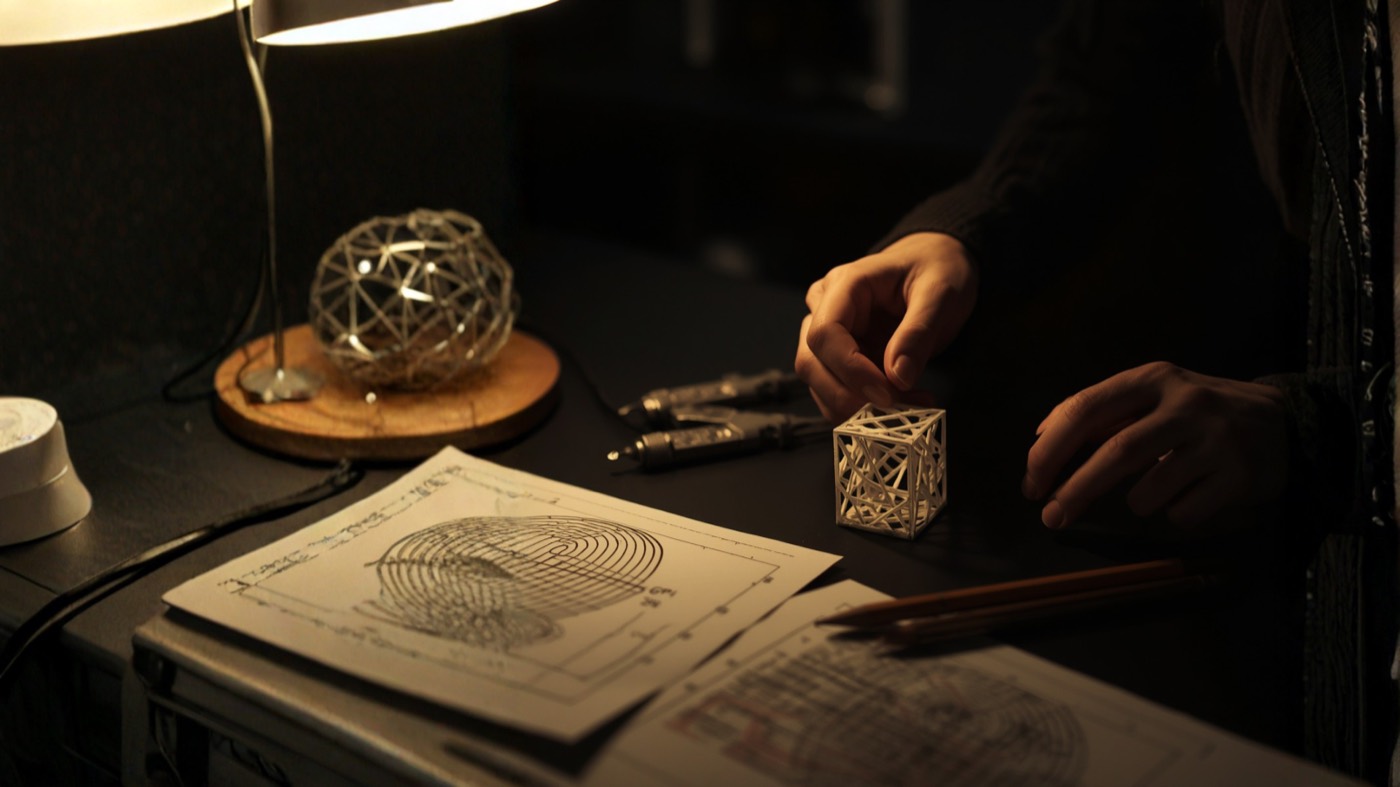
Our answer is a family of passive structures called Acoustic Rainbow Emitters. They are shapes rather than electronics, designed so the geometry itself steers sound along intended paths and away from where it would otherwise be heard. Because the behavior lives in the shape, there is nothing to power and nothing to cancel — the structure does its work simply by being the form it is.
It's a small shift in the question, but it opens a surprisingly large space of possibility — one that reaches anywhere the direction of a sound matters more than its volume.
How a machine is heard should be designed in — not bolted on.
We give machines control over where their sound goes — without drawing power or costing performance.
A world where a machine's sound is a design decision, not a problem discovered after deployment.
The world is listening more closely every year — sensors in the field, communities under flight paths, people who share space with machines. Whether a machine is tracked, trusted, or tolerated increasingly comes down to its sound. The machines that thrive will be the ones shaped, from the geometry up, to be heard on their own terms. That's the world Aurallius is building toward.
Built by someone who works where the physics meets the field.
Aurallius was founded by Rese Drucker, who works at the intersection of early-stage deep-tech productization and the standards that govern how autonomous systems are formally evaluated.
That standards work is deep and specific. Drucker serves as Automation Co-Chair within ASTM International Committee F38 on Unmanned Aircraft Systems — the body that develops the consensus standards governing how uncrewed aircraft are designed, tested, and operated. The contribution spans published and in-progress standards including noise assessment, air-risk, ground-risk, and operational-risk assessment, human factors for ground control stations, and software dependability. Drucker is also a member of JARUS (the Joint Authorities for Rulemaking on Unmanned Systems) and a named author on white papers published through NASA's m:N working group on multi-vehicle operations.
That vantage point is the reason Aurallius exists. Sitting where the physics meets the standards is what lets the company recognize where an acoustic principle genuinely applies — and, just as important, what would cause it to fail in a real deployment. Aurallius exists to carry an idea from principle to product the disciplined way — engineering against the constraints that decide whether a technology survives contact with the field.
We hold our claims to the standard our audience does.
The people who evaluate this work — operators, integrators, cities, investors — have seen enough hype to distrust it, so we don't trade in it.
We describe our technology in terms of what it's designed to do and what we intend to measure — not results we haven't produced. If a claim can't be defended, we don't make it.
Our differentiation is structural, not computational. The behavior is in the geometry; there's nothing to power, patch, or jam.
Our stage, without spin.
Aurallius is a U.S.-owned small business, ITAR, operating at an early feasibility stage. We've submitted a Phase I SBIR proposal to U.S. Special Operations Command, and our flagship program, GHOST-ARC™, is in active development. A provisional patent application covering the approach is in progress with IP counsel.
We're at the beginning of a long, technical road — and we intend to travel it the right way.
U.S.-owned small business · ITARIf this is the kind of company you want to work with, reach out.
Operator, integrator, public program, facility, or investor — there's a serious way to engage.
Start a conversation